The DOL Proposes New Joint Employer Rule: What Employers Need to Know
In the rapidly evolving world of labor and employment law, the U.S. Department of Labor (DOL) has signaled a significant shift with respect to the framework for joint employer liability. Indeed, the DOL recently unveiled a new proposed rule with the hope of promoting “greater uniformity and consistency [with respect] to the Department’s enforcement actions by adopting a transparent nationwide analysis, which could have benefits for all interested parties.” Under the proposed rule, the DOL seeks to:
redefine and expand the standard for determining “joint employer” status under the Fair Labor Standards Act (FLSA), the Family and Medical Leave Act (FMLA), and the Migrant and Seasonal Agricultural Worker Protection Act (MSPA); and
articulate different standards for vertical joint employment and horizontal joint employment.
What is joint employment?
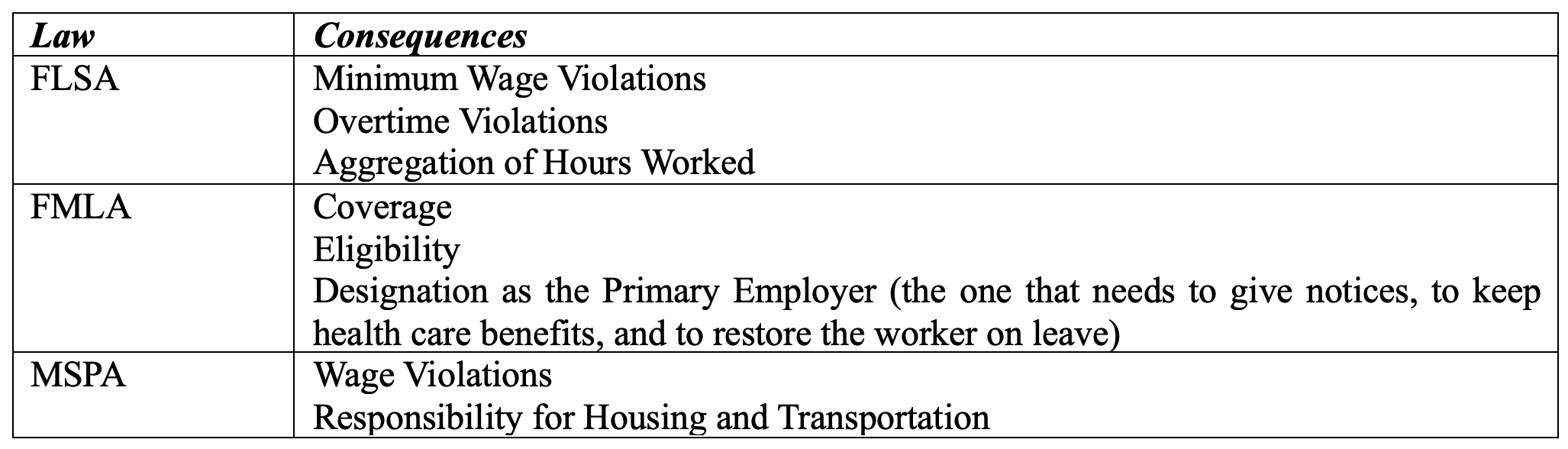
In general, only an employer is responsible for complying with U.S. federal laws and is liable for violating them. If, however, there is a finding that two or more individuals or entities are joint employers, both or all of them may be liable for violations. The chart below summarizes the practical consequences under these laws:
What is vertical joint employment and what is horizontal joint employment?
The first type of employment relationship arises where two or more employers jointly hire an employee and benefit from his/her/their employment, such as contractor and subcontractor and an employer and a staffing agency. The second type of employment relationship exists where an employee works for two or more employers in the same period of time and there is sufficient nexus between the employers with respect to that person’s employment. For example, a sales representative works for Dealership X and Dealership Y in the same week. Company ABC owns both dealerships, establishes and coordinates the sales representative’s schedules, and sets their salary, benefits, etc. at both locations.
What exactly does the new proposed rule do?
Now that we understand in which “direction” we are going, we can answer this question.
For the purposes of vertical joint employment, the DOL now asks employers to consider the following factors:
Who has the power to hire and to fire the employee?
Who supervises and controls the employee, sets his/her/their schedule, and establishes that person’s conditions of employment to a substantial degree?
Who sets the employee’s rate of pay and how that person will be paid?
Who keeps and maintains the employment records for that person?
Moreover, the rule underscores two considerations regarding the application of these principles. First, do not weigh the factors solely under an independent contractor analysis. Second, consider indirect control when applying the four factors.
As for horizontal joint employment, the DOL explained that two employers will be sufficiently associated to create a joint employment situation where:
there is an agreement between the two employers to share the worker’s services;
one of the employers is directly or indirectly acting in the interests of the other employer with respect to the employee;
the two employers directly or indirectly share control of the employee because one of the employers controls the other employer or the employers are subject to common control by another company.
There are carve-outs
The DOL clarified that certain business relationships will not automatically make joint employer status more or less likely include requiring anti-harassment policies or background checks through a contract, providing a sample employee handbook to another employer, offering an association health plan, participating in a joint apprenticeship program, or a franchisor/franchisee relationship.
Thus, the proposed rule provides business entities like staffing agencies, franchises, and subcontractors some clarity.
What should employers do now?
Before this new rule goes into effect, employers should consider taking the following proactive steps:
Review and adjust: Evaluate if and to what extent your organization collaborates with other organizations and read your agreements, discuss with counsel, and adjust relationships or revise established agreements if necessary or appropriate.
Submit feedback to the DOL: Employers may submit comments to the DOL, raise questions, highlight concerns, ask for clarification, and provide any other input by June 22, 2026.
Partner Giovanni Antonucci Di Cesare (giovanni.antonucci@pierferd.com) and Junior Partner Allison Bustin (allison.bustin@pierferd.com) are available to counsel and to address any compliance with equal employment opportunities and claims of national origin discrimination.
This publication and/or any linked publications herein do not constitute legal, accounting, or other professional advice or opinions on specific facts or matters and, accordingly, the author(s) and PierFerd assume no liability whatsoever in connection with its use. Pursuant to applicable rules of professional conduct, this publication may constitute Attorney Advertising. © 2026 Pierson Ferdinand LLP.