Key Takeaways
The U.S. Department of Labor (“DOL”) has issued a final rule on how to tell whether a worker is an employee or an independent contractor under the Fair Labor Standards Act (“FLSA”), the Family and Medical Leave Act (“FMLA”), and the Migrant and Seasonal Agricultural Worker Protection Act (“MSPA”).
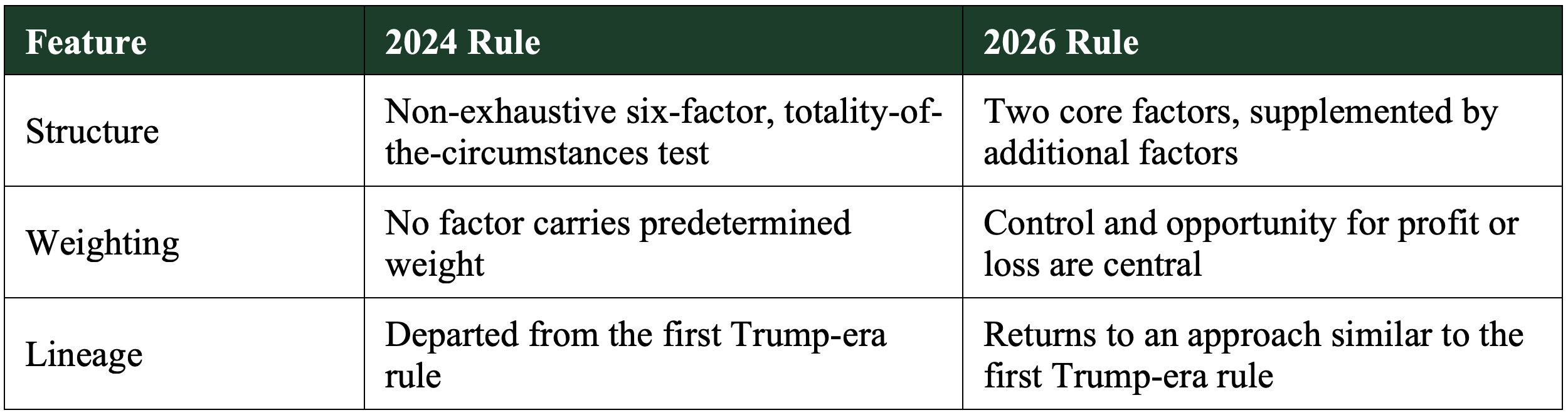
The final rule (the “2026 Rule”) replaces the 2024 rule (the “2024 Rule”) and its open-ended six-factor test.
At the heart of the 2026 Rule are two “core factors”: (1) the nature and degree of control over the work and (2) the worker’s opportunity for profit or loss based on initiative, investment, or both.
The 2026 Rule closely resembles the 2021 regulation adopted during President Trump’s first term.
If your business relies on independent contractors, now is a good time to review your classifications, contracts, and practices. Keep in mind that state law and private litigation may apply different standards.
Background
On Thursday, November 19, 2026, the DOL announced the final version of its rule, “Employee or Independent Contractor Status Under the Fair Labor Standards Act, Family and Medical Leave Act, and Migrant and Seasonal Agricultural Worker Protection Act.” The DOL first signaled it would revisit the issue in its spring 2025 regulatory agenda, stopped applying the 2024 Rule in its own enforcement on May 1, 2025, published the proposed rule in February, and later targeted October 2026 for finalization. The final rule tracks the February proposal closely.
On Thursday, November 19, 2026, the DOL announced the final version of its rule, “Employee or Independent Contractor Status Under the Fair Labor Standards Act, Family and Medical Leave Act, and Migrant and Seasonal Agricultural Worker Protection Act.”
Why does classification matter? Independent contractors generally don’t get the protections federal law guarantees employees, including minimum wage and overtime pay under the FLSA and job-protected leave under the FMLA.
Secretary of Labor Keith Sonderling described the 2026 Rule as an effort to end “regulatory ping pong,” saying the DOL is “establishing clear, predictable and easy to understand criteria for determining who is an employee and who is an independent contractor.”
The 2026 Rule comes down to one question: as a matter of economic reality, is the worker economically dependent on a putative employer for work (an employee), or in business for himself or herself (an independent contractor)? As Wage and Hour Division Administrator Andrew Rogers put it, “a worker is an employee if, as a matter of economic reality, he or she is economically dependent on an employer for work.”
Core Factors
Control. The nature and degree of control over the work, such as who sets schedules, selects projects, sets the workload, and determines how the work is performed, and whether the worker is free to work for others.
Opportunity for profit or loss. Whether the worker can earn profits or incur losses through personal initiative, investment, or both. Simply earning more by working more hours or working faster generally points toward employee status.
Additional Factors
The two core factors generally carry the most weight, and when both point the same way, that is substantially likely to be the correct classification. The 2026 Rule also considers other factors, which matter most when the core factors point in different directions, including:
the degree of permanence of the working relationship; and
whether the work is part of an integrated unit of production.
Two more points are worth noting.
First, the DOL emphasizes that what the worker and the business actually do matters more than what a contract says or what is theoretically possible. Second, economic dependence doesn’t turn on how much a worker earns or whether the worker has other sources of income.
The 2026 Rule also includes 14 fact-specific examples, and the DOL has issued an updated Fact Sheet #13 that businesses may find helpful.
Comparison to the 2024 Rule
Pending Litigation
Challenges to the 2024 Rule have been on hold in the Fifth, Sixth, and Tenth Circuits and in a Texas federal court. We expect those cases to be resolved or mooted now that the 2026 Rule is final. We also expect worker advocates may challenge the 2026 Rule itself, and we’ll be watching closely.
What the 2026 Rule Does Not Change
State law. Many states, including California, Massachusetts, and New Jersey, use stricter tests (such as the “ABC” test) for wage-and-hour, unemployment, and workers’ compensation purposes. Passing muster under the 2026 Rule doesn’t mean you’re compliant under state law.
Other federal laws. The 2026 Rule addresses only the FLSA, FMLA, and MSPA. Other regimes, such as federal tax law and the National Labor Relations Act, apply their own standards.
Courts. Courts don’t have to follow the DOL’s interpretation, especially after the Supreme Court’s 2024 decision in Loper Bright Enterprises v. Raimondo, though they may find the DOL’s analysis persuasive.
Recommended Next Steps
If your business works with independent contractors, here’s what we recommend:
Inventory current independent contractor relationships and assess each one against the two core factors.
Review contracts, statements of work, and onboarding materials so that they accurately reflect the worker’s control over the work and opportunity for profit or loss.
Make sure day-to-day practices match the paperwork. What controls is the economic reality of the relationship, not the label you put on it.
Confirm compliance with applicable state classification tests, which may be tougher than the 2026 Rule.
Calendar the 2026 Rule’s effective date. The rule takes effect 60 days after it is published in the Federal Register; publication is scheduled for November 23, 2026, which would put the effective date on or about January 22, 2027. Keep an eye on any legal challenges, too.
Calendar the Effective Date
Calendar the 2026 Rule’s effective date (60 days after it is published in the Federal Register), and keep an eye on any legal challenges.
PierFerd’s Employment Partners regularly advise businesses on worker classification, compliance audits, and related litigation. We’d be glad to help you take a fresh look at your workforce model under the 2026 Rule and applicable state law. Please reach out to Gordon Berger at gordon.berger@pierferd.com or your usual PierFerd contact with any questions.
The bottom line: the 2026 Rule gives businesses a clearer, more predictable federal framework, so this is a good moment to make sure your classifications hold up.
This publication and/or any linked publications herein do not constitute legal, accounting, or other professional advice or opinions on specific facts or matters and, accordingly, the author(s) and PierFerd assume no liability whatsoever in connection with its use. Pursuant to applicable rules of professional conduct, this publication may constitute Attorney Advertising. © 2026 Pierson Ferdinand LLP.