
FOR THE CYBER INSURANCE INDUSTRY
Resources for Claim Professionals, Underwriters & Brokers
Cyber claims move faster when the insurer, policyholder, broker, and breach counsel understand their respective roles. These resources explain how PierFerd CPT approaches first-party cyber incidents and provide practical tools that claim professionals, underwriters, and brokers can use with policyholders before and during a claim.
Active incident?
•
Contact PierFerd CPT Immediately
•
Call 833-737-7444
•
Email cyber@pierferd.com
•
Active incident? • Contact PierFerd CPT Immediately • Call 833-737-7444 • Email cyber@pierferd.com •
The Cyber Claim Relationship
How Breach Counsel Fits Into a Cyber Claim
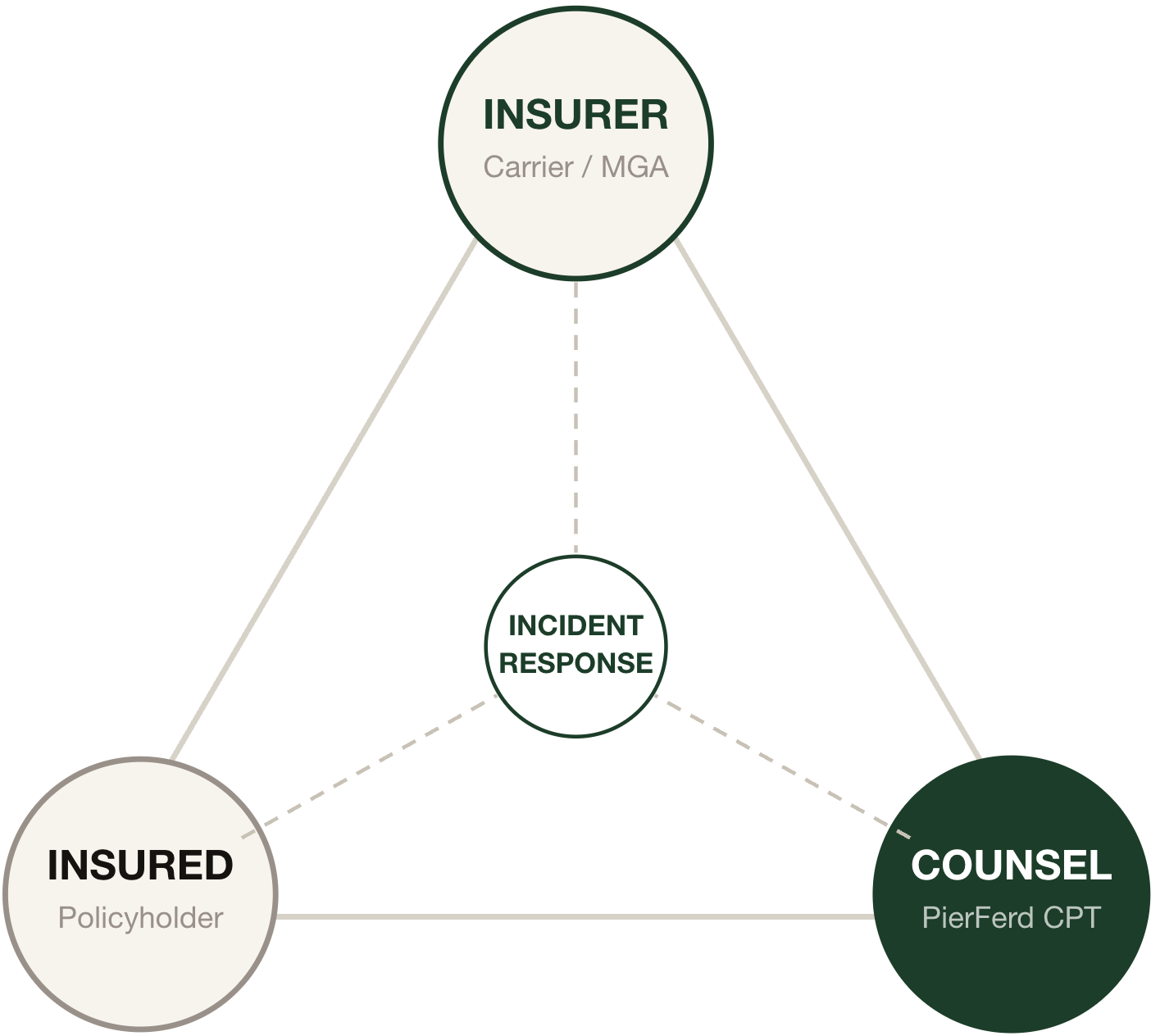
When a policyholder reports a cyber incident, three parties move at once: the insurer managing the claim, the policyholder responding to the incident, and breach counsel coordinating the legal response. Each holds a distinct role. When the relationship works well, each role reinforces the others.
Breach counsel does not adjust the claim or determine coverage. Breach counsel advises the policyholder on the legal response: helping structure the investigation to preserve applicable legal protections, coordinating the legal aspects of forensic and other response work, analyzing notification and regulatory obligations, and documenting key decisions as the incident develops.
Breach counsel also serves a different role from coverage counsel. Breach counsel represents the policyholder in responding to the incident. Coverage counsel advises on rights and obligations under the insurance policy. The roles are distinct, and both matter.
What Claim Professionals Should Expect from PierFerdCPT
— Speed. Our goal is to triage within hours, not days, and staff active matters immediately.
—Efficiency. PierFerd is an AI-native law firm. We use approved AI tools and experienced lawyer staffing to reduce unnecessary handoffs and administrative time.
— Clear reporting. We deliver status updates that give claim professionals what they need to manage the file, without burying the signal in legal noise.
—Vendor coordination and advocacy. We coordinate forensic, notification, and other response vendors, keep the process moving, and protect the policyholder's interests throughout.
— Regulatory navigation. We identify notification obligations across all applicable jurisdictions and manage regulatory deadlines from day one.
Attorney-Client Privilege
How Privilege Works During a Cyber Claim
The investigation record created during the first days of an incident may later become important in litigation or regulatory proceedings. Attorney-client privilege and work-product protection can depend on the purpose of the work, the participants, how communications are handled, and the applicable jurisdiction. Counsel’s involvement can help preserve applicable protections, but it does not automatically make forensic work or incident communications privileged.
-

Why It Matters
A forensic report describes what happened, what failed, and what the organization knew. In the wrong posture, that document becomes a roadmap for plaintiffs and regulators. Privilege and work product protections exist to let an organization investigate candidly and receive legal advice without creating discoverable admissions. Protecting that space starts in the first hours, not after the fact.
-

Counsel-Directed Forensics
Protections are most likely to apply when counsel retains the forensic firm and directs the investigation for the purpose of providing legal advice. Courts examine substance over labels. A forensic firm working under a pre-existing ordinary-course agreement, producing the same report it would have produced anyway, may receive no protection at all. The engagement structure matters from day one.
-

Communication Flow
During an incident, communications should run through counsel and reach only those who need them. Mixing business and legal purposes in a single document weakens protection for both. Many organizations maintain two work streams: a legal stream directed by counsel, and an operational stream for restoration. Disciplined separation preserves options later.
-

Common Pitfalls
Courts have ordered production of forensic reports where organizations circulated them broadly, shared them with auditors or third parties, repurposed pre-incident vendor contracts mid-incident, or used the report as an operational remediation plan. Each of these choices feels efficient in the moment. Each one can convert a protected analysis into discoverable evidence.
Claim professionals benefit from understanding this framework because decisions made early in an incident can affect the discoverability and defensibility of the investigation record. This material is educational only and is not legal advice for any specific situation.
Working With PierFerdCPT
What Happens After an Assignment
PierFerd CPT is approved on more than 40 cyber insurance panels and has worked within a wide range of carrier billing structures, workflows, and reporting expectations. Here is how a typical first-party assignment runs.
-

Assignment
CPT receives the assignment and contacts the policyholder within hours
-

Triage
We assess incident type, scope, and immediate legal issues, and sequence evidence preservation.
-

Vendor Coordination
We engage forensic and response vendors through counsel and report early findings to the insurer.
-

Legal Analysis
We identify notification obligations, calendar regulatory deadlines, and maintain privilege throughout.
-

Resolution
We complete notifications, deliver the final attorney report, and defend regulatory or litigation follow-on as needed.
Resource Library
Tools You Can Use and Share
Three working tools drawn from PierFerdCPT’s own practice. Use them for your own education, walk through them with a policyholder, or share them as pre-incident preparation.
-
For Claim Professionals For Brokers
This framework walks through the questions that bear on whether an extortion payment is even an option: backups, proof of decryption, proof of exfiltration, the nature of the data at risk, sanctions exposure, and notification obligations. It never recommends payment. At every branch it directs the user to confer with legal counsel. Use it to understand how breach counsel structures the payment conversation, or walk a policyholder through it as pre-incident education.
-
For Brokers Share With Policyholders
When a fraudulent wire goes out, the recovery window may close within hours. This checklist sequences the response: bank, law enforcement, recipient bank, internal teams, and regulators, in the order that maximizes the chance of freezing and recovering funds. Brokers can share it with policyholder clients as pre-incident preparation.
1. Contact Your Bank
Notify your bank’s fraud department immediately and request a SWIFT recall or wire recall.
Ask the bank to initiate an immediate recall or reversal and provide any required indemnification or authorization documentation.
Request that your bank contact the recipient bank to freeze the fraudulent account.
Obtain written confirmation of your bank's action (e.g., SWIFT recall message, email from fraud team).
2. Contact Law Enforcement
File a detailed complaint with the FBI’s Internet Crime Complaint Center (IC3) immediately. Depending on the transaction and available information, law enforcement may initiate additional asset-recovery measures, including the Financial Fraud Kill Chain process.
For significant or time-sensitive losses, contact the appropriate FBI field office in addition to filing with IC3.
If the FBI is not responsive, file a report with the Secret Service's Cyber Fraud Task Force (CFTF) via your regional office.
Obtain a police report or case number for tracking purposes.
3. Contact the Recipient Bank Directly
Request the recipient bank’s fraud department to freeze the fraudulent account.
Provide proof of fraud (e.g., fraudulent invoice, email chain, wire details).
Request written confirmation of action taken by the recipient bank.
4. Notify Your Internal Teams
Alert finance and treasury teams to halt any further payments to the fraudulent account.
Alert IT and cybersecurity teams to check for email compromises.
Alert legal to assess next steps. PierFerd CPT: cyber@pierferd.com | 833-737-7444 (833-PF-SSHHH)
5. Escalate with Regulators if Necessary
If your bank is unresponsive, escalate to its primary regulator (e.g., OCC, FDIC, Federal Reserve, or CFPB).
If the recipient bank is non-cooperative, consider filing a complaint with foreign banking regulators if applicable.
Act within the first 24 to 72 hours. Document every step. Beware of follow-up fraud attempts; scammers may pose as recovery agents to further exploit the situation.
-
For Brokers Share With Policyholders
Six elements every practical incident response plan should cover. Brokers can use this with policyholder clients ahead of renewal: a client who can check every box presents a stronger risk, and a client who cannot has a concrete preparedness agenda. Effective plans exist to make decisions fast, predictable, and defensible.
01 • Purpose
Define the purpose and scope of the plan
02 • Scope
Determine who this plan applies to
03 • Accountability
Identify who owns implementation, maintenance, and execution
04 • Team
Named individuals with direct contact info, not just titles
05 • Procedures
Detection and discovery
Escalation
Investigation
Containment and remediation
Evidence preservation
Communications and notification
Post-incident review
06 • Training
Train the response team and test the plan through exercises. An untested plan is a hypothesis
PierFerd CPT offers IR plan gap review and tabletop exercises as flat-rate engagements. cyber@pierferd.com | 833-737-7444
PierFerd CPT Matter Data • Updated Quarterly
What We’re Seeing in Our Matters
Aggregated, anonymized observations from PierFerd CPT’s first-party cyber incident-response matters. These figures describe our practice experience, not the cyber market as a whole.
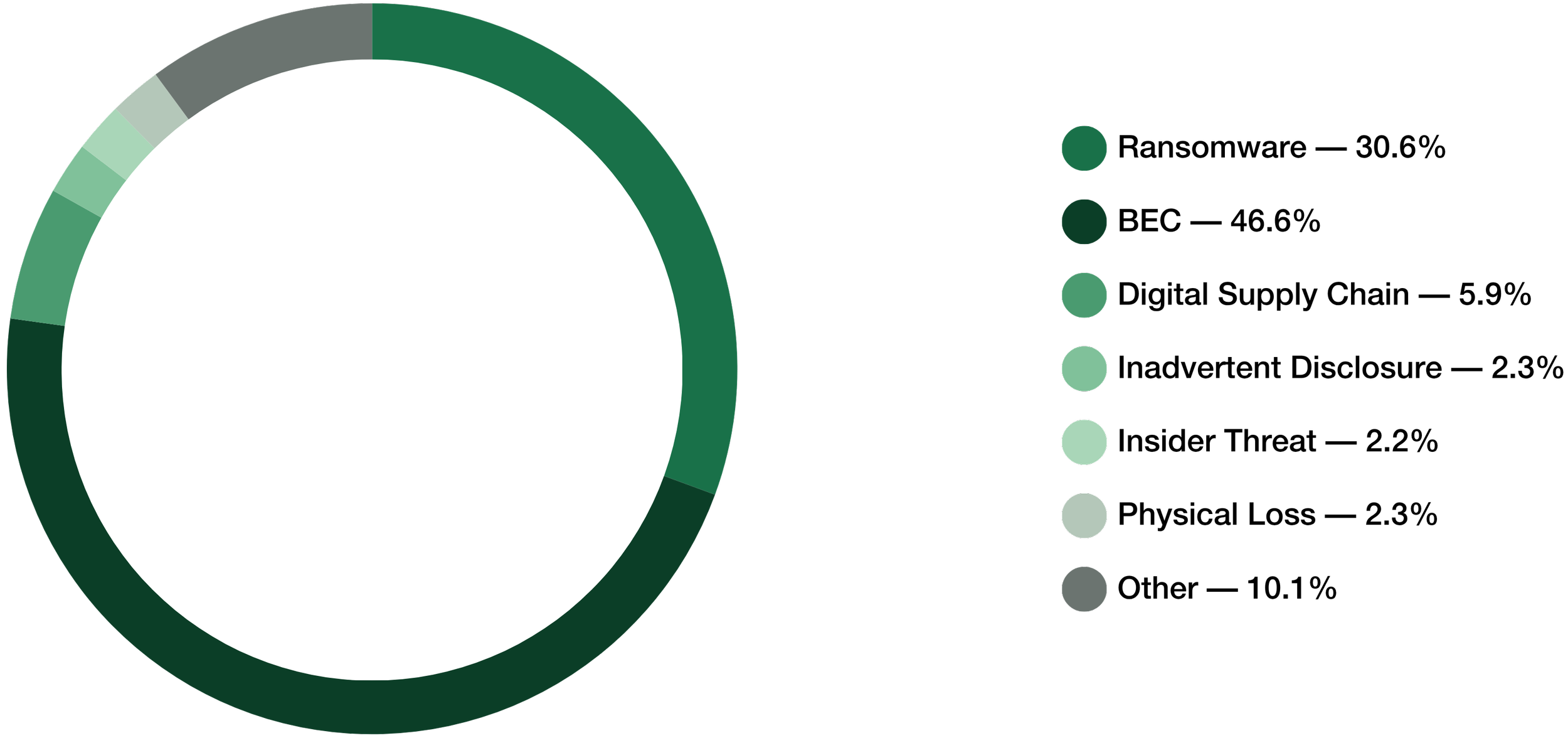
Ransomware & BEC Drive Majority of Claims
Ransomware and BEC events dominate first-party cyber claims handled by PierFerd, accounting for over 77% of activity.
23.1% of ransomware claims result in payment
PierFerd Cyber Works Across Multiple Industry Sectors
Cyber claims span nearly every industry, led by professional services, financial services, and education, demonstrating that cyber risk is not confined to one sector and requires tailored strategies across diverse industries.
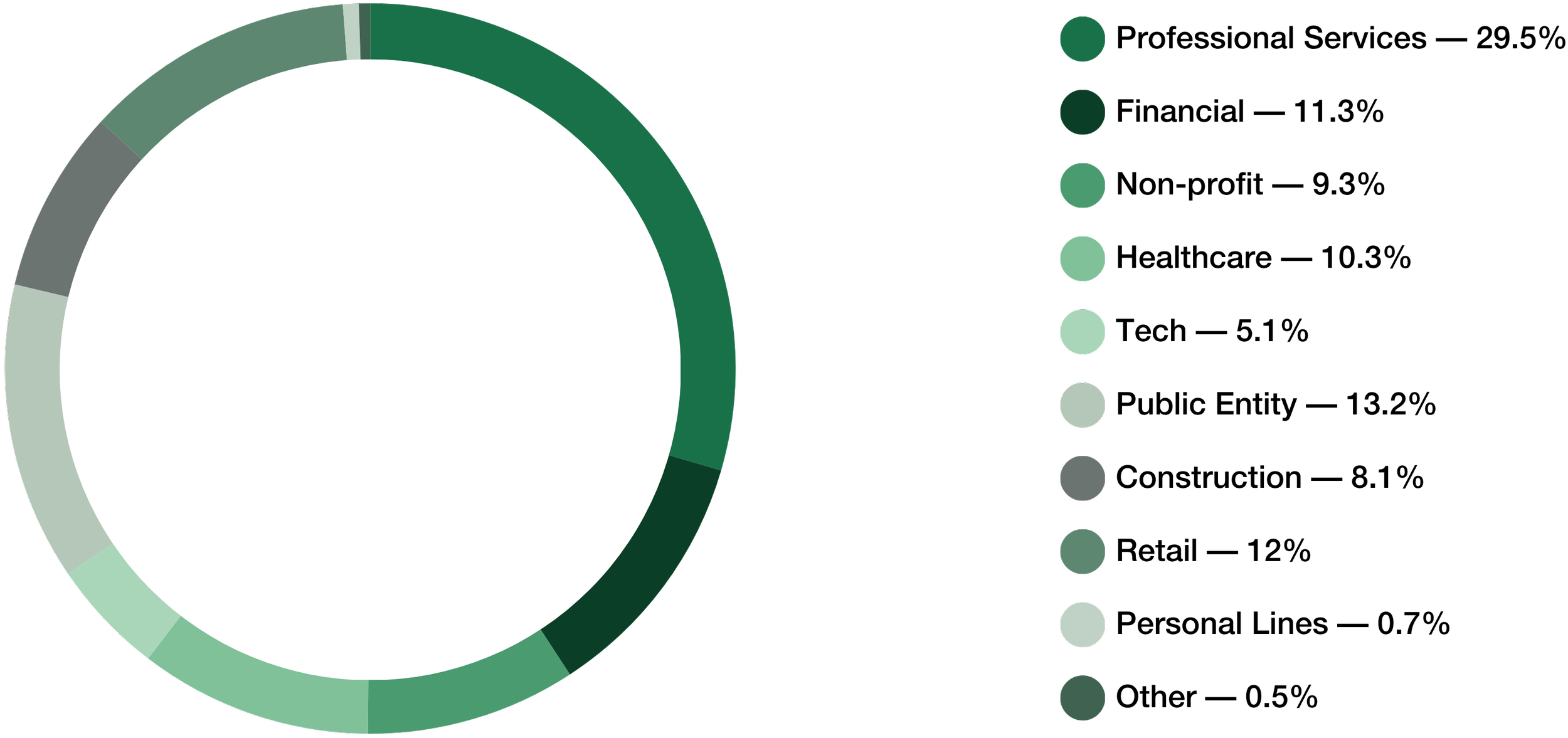
Source: PierFerd CPT matter data, aggregated and anonymized. Updated quarterly. These figures reflect our practice group experience and are not intended to represent the cyber market as a whole.
This content is for general educational purposes and does not constitute legal advice or create an attorney-client relationship.